
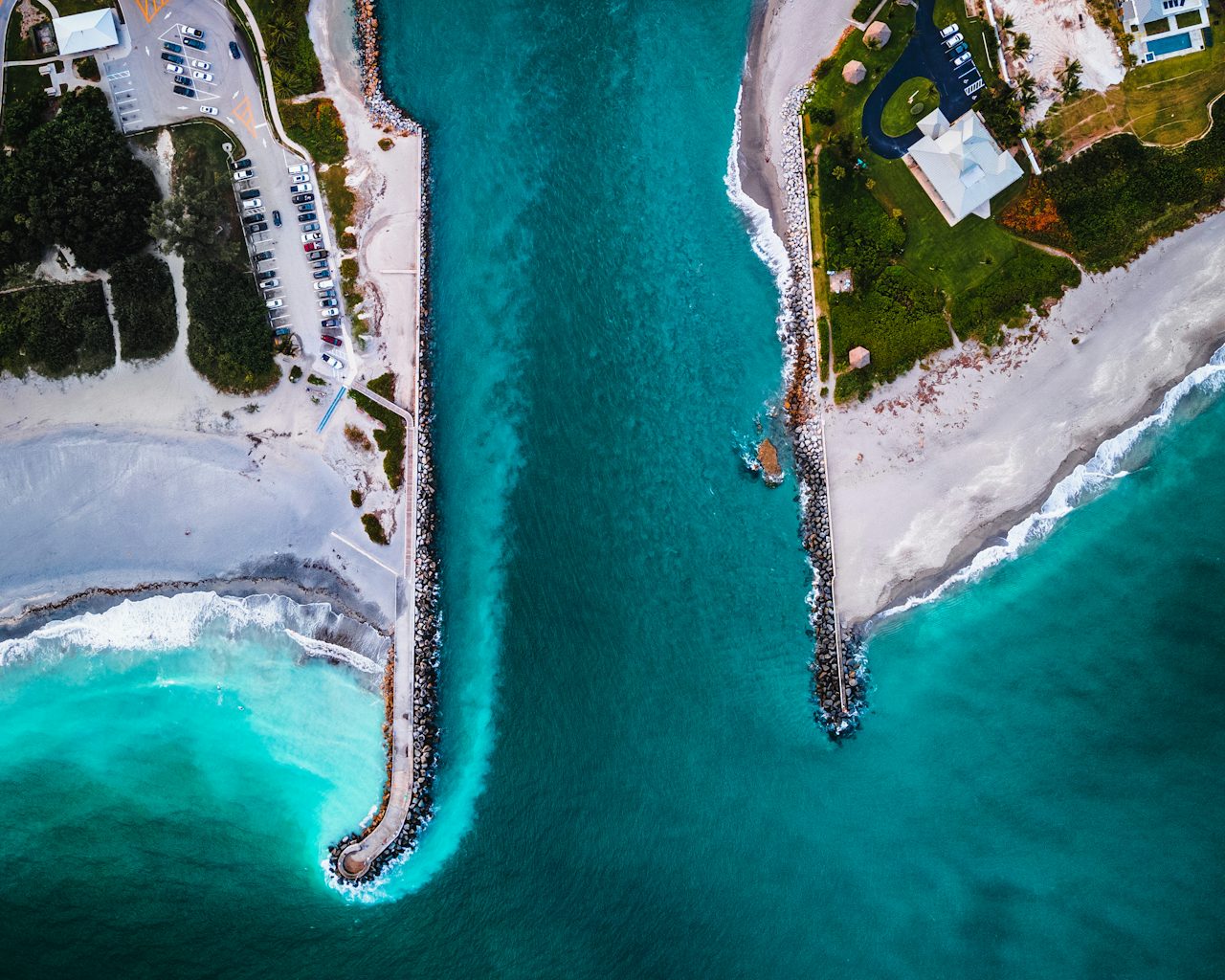
A jetty is the strangest piece of fishing structure Florida gives you for free: a wall of rock that reaches out of the sand and drops you into thirty feet of moving water without a boat. Snook, redfish, tarpon, flounder, sheepshead and Spanish mackerel all use it, all for the same reason — the rocks break the current and everything edible gets pushed past the same corners. Jetty fishing in Florida is the highest-percentage shore game in the state when you do it right, and a very expensive way to lose tackle when you don’t.
Why a Jetty Out-Fishes the Beach Right Next to It
Three things stack up on a jetty that almost never stack up together anywhere else you can walk to:
- Deep water within a cast. An inlet channel is dredged. You are standing on the edge of it, not two hundred yards short of it like you are on the open beach.
- Current with an edge. Rock breaks flow. Every boulder throws a small eddy, and predators sit in that slack water facing into the push, waiting for bait to tumble out of it.
- A bait highway. Everything leaving or entering the bay on a tide funnels through the cut. In September that means the mullet run, and jetties turn into the best show in Florida.
The trade-off is that a jetty is unforgiving of sloppiness — of your footing, your leader, and your plan for what happens when something big actually eats.
Read the Rocks: Four Zones, Four Different Fisheries
Most anglers walk to the end and stop thinking. The end is one of four spots, and often the worst of them.
- The channel side — the deep face, along the boat cut. This is the snook and tarpon edge on moving water. Cast tight to the rocks and work the lure back with the current, not against it.
- The surf side — shallower, sandy, with a trough running along the rock. This is where pompano, whiting and flounder feed, and it is the side almost everybody ignores.
- The pocket — the corner where the jetty meets the beach. Bait piles into it on a falling tide and gets ambushed. Small, obvious, and consistently the best hundred feet of the whole structure.
- The tip — open water, the deepest and the streakiest. Spanish mackerel, jacks, tarpon rolling on the edge of the outflow. Great when bait is showing on top; dead for hours when it isn’t.
Work them in that order rather than marching straight to the end, and you will fish four spots instead of one.
Tide Is the Whole Game
Nothing about a jetty is worth much on slack water. The rock only holds fish when water is moving past it — the whole mechanism is bait losing a fight with current.
- Outgoing: the bay empties through the cut and flushes bait, crabs and shrimp out to the predators stacked along the channel side and the tip. Usually the stronger bite.
- Incoming: cleaner, greener water pushes in along the surf side and the pocket. Better for sight-fishing and for redfish working the shallow edge.
- The last hour of light on a moving tide is the highest-percentage window on the whole structure — and the reason serious jetty anglers plan the trip around the tide, not around the weekend.
Check the swing before you drive: our live Florida tide charts and solunar bite times will tell you whether you are looking at four hours of push or a lunch-hour of slack.
One Setup That Covers a Whole Jetty
You can carry three rods across wet boulders or you can carry one and keep a hand free. Carry one. A 7′6″–8′ medium-heavy spinning rod with a 4000–5000 reel throws a 1 oz bucktail, handles a live mullet, and still has the backbone to steer a fish away from rock. Braid to a heavy fluorocarbon leader — on a jetty the leader is not for stealth, it is abrasion insurance.
Two things matter more here than anywhere else you fish: line that survives contact with barnacles, and a knot that does not hinge. See the braid we recommend for Florida saltwater, our inshore rod picks, and — genuinely the difference between landing and losing on rock — the knots that actually matter.
Best paired with: 40–60 lb fluorocarbon leader, a full arm’s length of it. Rock chews through 20 lb in one head-shake.
Four Rigs That Cover Everything a Jetty Holds
| Rig | What it is for | Where to throw it |
|---|---|---|
| Bucktail or heavy jig, 3/4–1½ oz | Snook, jacks, flounder | Channel side — cast up-current, let it tick bottom on the swing |
| Free-lined live bait (mullet, croaker, pilchard) | Big snook, tarpon | Channel side and the tip, on moving water |
| Knocker or fish-finder rig | Redfish, black drum, sheepshead | Tight to the rock, on the down-current side |
| Small silver spoon or long-casting plug | Spanish mackerel, bluefish, ladyfish | The tip, whenever bait is flickering on the surface |
Bait beats lures on a jetty more often than it does anywhere else — the fish are ambushing, not chasing. If you can throw a net, a bucket of fresh bait is worth more than anything else in the bag: see how to throw a cast net and how to catch live bait in Florida.
Landing a Fish on Rocks — the Part Nobody Plans For
This is where jetty trips fall apart. You are standing several feet above the water on a surface you cannot walk backwards on, and a good fish will use the rock deliberately.
- Decide your landing spot before you cast. Find the low flat boulder or the beach corner you will walk the fish to — then fish within reach of it.
- Walk the fish, do not lift it. Lifting a big fish vertically breaks rods and leaders and kills fish you meant to release. Lead it along the rock to your spot.
- Bring a lip grip or a long-handled net. Hand-landing a fish on wet rock is how people end up with hooks in their palms.
- Keep the rod low and steer sideways. Side pressure turns a fish out of the rocks; lifting drives it into them.
Footing, Waves and the Rules That Keep You Alive
Florida jetties are car-sized granite boulders with gaps you can drop through, and people are seriously injured on them every year. This is not a formality.
- Studded or rubber-cleated boots, never bare sneakers. Wet algae on granite has roughly the friction of ice.
- Never wear waders on a jetty. If you go in, they fill.
- Watch the set, not the average wave. Rocks that have been dry for ten minutes get washed by the seventh wave.
- Do not fish the tip in a hard onshore wind or a big swell. The rocks that look fine from the beach are the ones taking water at the end.
- Inlet current is not swimmable. East Pass in Destin and every other cut in the state have taken strong swimmers. Stay out of the water beside the rock.
- Go with someone, and carry a headlamp if there is any chance you are walking back in the dark. Every jetty gets twice as hard to cross at night.
🎥 Watch: jetty baits and rigging
Video: Salt Strong — “Catch BIG Fish On The Jetties.”
What Is Legal Off the Rocks Right Now
Jetties hold a dozen species with a dozen different rules, and the season that matters most this week is snook. Snook harvest reopened Tuesday, Sept 1 in the Panhandle, Big Bend, Tampa Bay, Sarasota Bay and all three Atlantic regions — but Charlotte Harbor and Southwest stay closed until Oct 1. The slot is 28–33″ total length on the Gulf and 28–32″ on the Atlantic; one fish per person per day; a snook permit is required on top of your saltwater licence. (FWC, verified 2026-08-29.) Full detail in our 2026 Florida snook season guide.
Switch species in the checker above before you put anything in a cooler — flounder, sheepshead and redfish all run on different clocks, and jetty anglers catch all three in the same afternoon.
Five Florida Jetties Worth the Walk (and One That Is Closed)
- Sebastian Inlet, Brevard / Indian River. State-park jetties with railed catwalks, and 24-hour access on the north side. Night fishing here is legendary. Bridge work on the access highway means traffic, not closure. See our Indian River Lagoon guide.
- Jetty Park, Port Canaveral. Jetty plus a 1,200-foot pier, easy parking, genuinely family-friendly. Day visitors until 9 pm; campground guests fish it around the clock.
- Fort Pierce Inlet, St. Lucie. Big-snook water on the outgoing, deep and fast. Treat the current with respect.
- Ponce Inlet, Volusia. The north-side rocks and the beach pocket beside them — reds, flounder and a serious fall run. Close enough to Mosquito Lagoon to switch plans if the wind ruins the coast.
- East Pass, Destin. The Gulf entry on this list, reachable on foot from the O’Steen Beach access and Norriego Point, which reopened after renovation with a boardwalk, restrooms and paid parking. Redfish, black drum, sheepshead and flounder off the rock. See the Panhandle guide.
- ⚠️ Venice South Jetty (Humphris Park) is closed. The parking lot reopened, but the jetty walkway itself has been shut since storm damage and there is no reopening date — a repair-cost report is not due until November 2026. Plenty of older articles still list it. Fish the Venice Pier instead, or check our best fishing piers in Florida.
Access rules, hours and closures change fast on public jetties — check with the managing park before you drive.
If the rocks look like more than you want to take on, a guided trip covers the same inlet water from a boat: browse Florida inshore and inlet charters.
Bottom Line
A jetty rewards planning more than skill. Pick the tide first, fish the pocket and the channel side before you bother with the tip, carry one rod and a leader heavy enough to survive the rock, and decide where you are landing a fish before you hook one. Wear cleats. Then go on the first strong outgoing tide after Sept 1 and find out why everybody else is standing at the end doing it wrong.
Keep reading: the complete Florida pier fishing guide, how to catch snook in Florida, and the fall bull redfish run — which fires in these same inlets from September on.
Seasons and limits change — always verify at MyFWC.com before you harvest anything.
Heads up: some links above are affiliate links. Buy or book through them and we may earn a small commission — no extra cost to you. Thanks for keeping the lights on.